My Recent Pictures

Wednesday, November 29, 2006

New Pictures and Family Visit

New pictures are up from my trip to Manali. Click the link below the rolling slides in the future to see all of the pictures. The full slide show has all the pictures from my trip so far. Click on the pictures to read the caption. Special thanks goes to my father and sister who have contributed, yet again, stunning pictures to the Dave family photo collection.

In other (and more interesting) news, my family has come to visit from the states. My sister stayed for a week in which we journeyed to Rajasthan (Jaipur and Ranthambore Nat't Wildlife Reserve). The pictures are up, but I'll write about it later. She left, but my parents stayed. We are currently in Gujarat after celebrating the 86th Birthday of my Guru, Pramukh Swami Maharaj. It was a pretty intense birthday party, if you will, considering that 250,000 people came to the festivities on the last of the three days alone. More on that later.

Enjoy the pictures. And thanks to the anonymous commenter (KM) for the kind words. I hope my trip to India is filled with experiences like that.

Saturday, November 18, 2006

The Krishna Mandir and Divine Intervention

On the suggestion of the stone-worker (from the previous post), I began the journey uphill to find the Krishna Mandir. About 3 Km uphill, I realized I was lost. I also realized I was thirsty, and worse, hypoglycemic. I had two cups of tea before I left for Naggar since none of the breakfast stalls were open. It was now 2 PM and I needed food. I decided to give up and head downhill to a little Italian joint that had a four cheese pasta that was making my mouth water. Ahead I saw sunlight shining brightly in a clearing - I figured this was a sign, so I headed in its direction. Another uphill climb and I came across a troop of monkeys. Not what I was expecting. But the road went around a corner, downhill, on the other side of the hill from Naggar. Not wanting to get lost I turned around for food, figuring I at least found some wild monkeys. I made it about a kilometer downhill when I came across three women carrying their moss-filled baskets. They looked surprised to see me and the words slipped out of my mouth "I couldn't find the Krishna Mandir so I'm heading down" as if I needed an excuse to be walking downhill. "But it's only just a bit up the hill." And at that point I decided that, no, He really was calling, so I would leave my health state in His hands and go have His darshan.

As I came back up the hill, I realized I was retracing steps. I came across the clearing where I saw the monkeys. But the road around the corner was calling, and I couldn't look away. And so I started walking. And only 200 yards down that road was the Mandir. A beautiful, old, isolated, and hidden mandir. I had been so close. I took my shoes off and went inside and knelt before Krishna's murti and thanked Him for His darshan. Exhausted, I sat down, ready to faint from the lightheadedness.

And literally, right at that moment, the pujari came from around the corner holding a pot of jal and a laddu. "Don't ask me how, but Krishna made me to keep some jal and laddu ready this morning. I think He meant it for you."

This is perhaps what I would call my first really spiritual experience. Call it coincidence, call it divine intervention. But that laddu and few sips of water kept me from passing out right there at His feet. "Sit and relax," said the pujari, "where are you from?" "America." (Laughter) "That's amazing. People from Naggar hardly come up here!"

It's a pity that they don't. It has the most spectacular view of the Kullu Valley - trumped every other one by far. And the only sound is the wind. Even the engine sounds of the cars in the valley below didn't carry to the mountain top. After about an hour of drinking in Krishna's murti and the beauty of His creation, I realized how hungry I was. And no kidding, right at that moment, the pujari came out with a steaming hot plate heaped with rice, daal, and rajma. "You must be hungry - you must not leave without having some prasad." Screw four-cheese pasta. That was the best meal I've had... maybe ever. And with the best view ever. Me, my food, and the sound of the wind.

I've always heard that God takes care of His seekers. Take one step toward Him, He takes ten toward you. For the first time, I really experienced it. I wanted to give back - "Is there some seva I can do?" I inquired. "No, we're just a simple mandir." "Then can I leave a donation?" The pujari laughed. I didn't understand what was so funny. Then I realized why he was laughing.

In the first temple, church, mosque, anywhere that I've really deeply wanted to leave a donation - there was nowhere to leave it. No accounting office, no record book, not even a daan peti.

Figures.

Naggar

I was up at 6 AM on the morning of the 16th to catch one of the first buses headed to the town of Naggar. On Nirja mami's suggestion that it was a beautiful place (I didn't find out till later that she hasn't been there herself), I decided to go. It turned out to be the highlight of the trip.

The Rs. 15/- busride took about 45 min. and was my first experience with India's public bus system. Totally not as bad as people make it out to be. It was crowded like you wouldn't imagine, but not actually uncomfortable. I had to keep asking 'How far to Naggar?' to make sure I didn't miss the stop, but I eventually made it. My first stop on the climb up the hill was the Gauri Shankar Mandir, a 12th century temple dedicated to Shiva. The first thing I noticed was that I recognized the carvings. The lotus shapes, the plant pots at the tops of the pillars. They looked like older versions of the Swaminarayan Mandirs that BAPS is building now. There will be some pictures up for comparison.

The highlight of Naggar was not the temples, though. As I looked uphill, I saw a waterfall and decided I would climb to its source. As I climbed up its downhill stream, the sounds of the town, then the village soon faded away. I figured I would be all alone again. Then up ahead I saw a man sitting on the rocks by the stream, by himself. I folded my hands when he saw me as a silent namaste. As I reached him he asked where I had come from, and if I had spent a lot of energy climbing up the streambed considering that there was a dirt path not more than 10 feet away just up the embankment. I laughed and answered that had I been on the road, I wouldn't have noticed him sitting there. That's true, he said, have a seat. And he flipped over a stone so I could sit on its flat side.

He's a stone worker. You can see his colleague at work carrying stones in the recent pictures (my acquaintance is in the background). It's a brutish job, carrying 35 kilos of stone on your back like that. For the next half hour, though, my Rice degree gave way to the wisdom of a poor stone worker from the villages of India whose insights into life and religion left me thinking for the rest of the evening.

I came to India to see how Hinduism is practiced in its homeland. This stoneworker gave me some amazing insights. As we commented back and forth on the peacefulness of the surroundings he said,

"That's God's grace - you are made to live in a big, noisy, dangerous city. Yes, you have wealth and money, but you have no peace - that's punishment! Here there is peace. I'm not rich, but then again, I don't have to worry about trains blowing up or whether I can afford the rent. If I don't work, I don't get rotis. So I work for food. If I get it, it's thanks to Him. If I don't, it's thans to Him. I work for food. The rest is up to Him.

"I could make paisa into a Bhagwan like the city people do, but what good would that do? You think it brings you convenience, but its really just more of a headache. You wash your clothes in 10 minutes in a washing machine, but then work for hours to pay the electric bill. Big cars get stuck in big traffic. The worst traffic here is my neighbors herd of cows.

"I hear that in the city they think that God has forgotten us villagers. Bhakwas! (Garbage!) I have seen the madness of city life. It turns garibs (poor people) like me into bhikharis (beggars). God gives me the strength to work, the serenity of nature to surround myself with, and the protection of a village where I don't have to even have a door on my house to lock in the first place. I have food on the table and I have peace. I know what I could have if I worked harder, but frankly, I don't want it."

I get the impression that he's spiritually light-years ahead of the rest of us, and he doesn't even know it. I asked him if he goes to the mandir.

(Laughter) "Of course - I have darshan every morning at the Krishna mandir at the top of the hill. You should go there." And that was it. No satsang sabhas or large gatherings. Darshan in the morning for him was enough for God to pervade his whole day. I began to understand how Hinduism worked in the villages. It's not a religion in the villages. It's not something that is practiced. It is simply lived from moment to moment. It manifests as a contentedness. A freedom from want. In fact, every villager I saw higher up in the hills of Naggar was just that - content. Not because they didn't know what they could have. But simply because they didn't want it.

I began to wonder if they pitied my state of materialism.

Vashisht Village and Freedom

I made the next morning a late one, and walked out of my hotel around 10 AM to make the 3 Km uphill hike to the village of Vashisht. I'm walking everywhere and in the rarified mountain air, it's taking its toll, but I don't mind huffing and puffing my way along in air this fresh. You couldn't pay me to take one of those kerosene-doped rickshaws.

The village was supposedly founded by Vashisht Muni. Considering that he was Ramchandra Bhagwan's teacher in Treta Yuga, this town is pretty old.

The village itself is very quaint but unfortunately has been tainted by tourism. It's filled with cheap guesthouses and cheap dhabas (food stalls). I tired of the town quickly and kept moving uphill. Eventually, I reached the backside of Vashisht and as I walked through the maze of backstreets, I began to get the "What are you doing all the way back here?" looks from the residents. I ended up on a woodland trail and on a whim, decided to see where it led. I found a babbling brook and followed it up about 1.5 km, above all the houses and steppe farms. I sat there for an hour on a small stone slab that had been made into a crossing over the brook but hadn't been walked on in years, judging by the plant growth. I had an amazing feeling of freedom sitting there by myself. I could follow whichever path my mind fancied, and this far away from the town, there wasn't anyone to harass me to buy Kullu shawls - hell there wasn't anyone period. But I wasn't lonely - not in the least. Just peaceful. Feeling thirsty, I dipped my hands into the cold water for a drink. It was crystal clear moutain water. Cold and tasteless - pure snowmelt - just like water should be. I emptied my bottle of mineral water and filled up with the good stuff. This water was so delicious I was willing to pay whatever gastrointestinal price necessary to enjoy it. I suspected though, that there wouldn't be any.

As I trekked back downhill alongside the brook, I came across the first signs of civilization again - a trashheap dumped down into the brook gully. I'm guessing the water there charges a GI fee. It makes me sad that even the most beautiful parts of India are trashed by the locals themselves.

It makes me wonder. India needs the economic boon that tourism can give, but I am not entirely certain this country is ready for a tourist rush. The cheat-first-ask-questions-later attitude of the touts, rickshawwallas and the wannabe-priests combined with the dump-your-trash-wherever attitude of just about everyone except the tourists makes India a place that needs a change of heart before it reaches for the wallets of tourists. Otherwise they will come in droves once, and never come back. In all fairness, every country has this problem, but the economic disparities in India make it so in-your-face here that one has to make an effort to see the amazing beauty and rich culture that lays beneath it.

As I walked back through the town I stopped to eat at Chauhan's dhaba - and had one of the tastiest Malai Koftas EVER. Steaming hot. Perfectly spiced. Scrumptious. And filling. I then went for darshan in the town center's two temples, one dedicated to Rama and one to Vashisht Muni himself. The murtis in Rama's mandir are more classical, but the Vashisht murti is of the older stone-slab-relief design. It's really interesting to see the merging to philosophical lines of thought in practice in India. In Rama's mandir, the main sanctum has Rama, Lakshman, and Sita, but Hanuman is outside alongside a shivaling. Philosophically, the Vaishnavite tradition which includes Hanuman is very different than the Shaivite tradition - the Shankaracharyas and the Gurus will debate that to no end. My guess is that to the lay person, they are all just God. If they can't read the road signs, what can be said of the scriptures?

More on the practice of Hinduism in India later. Vashisht got boring by 4 PM and I turned in early back to Manali. I walked alot. Like 10 Km a day. Why is my potbelly still there?

The Rohtang Pass

The second day was taken up by a visit to the Rohtang Pass. This 13,000 ft.-above-sea-level pass is the Kullu Valley's only access point to the cities further north in Himachal Pradesh. Tourist buses (Rs. 210/- roundtrip) take visitors up to the pass, then bring them back to Manali. The day I visited (Nov. 14th) was the last day it was open to tourists because of heavy snowfall the night before. After that, only commericial vehicles can pass through it - and at their own risk.

The fresh snowfall made the place very serene. But its ability to erase tracks quickly gave an inkling of how forbidding a place the mountains can be. As soon as we got down, I moved quickly away from the bus (read: other people) and into the mountains. The 10 minutes of silence was stunning, for lack of a better word. The only sounds were my feet crunching the fresh snow, and the wind blowing more snow over my tracks. I came across some powerlines upon which hundreds of prayer flags had been hung, but further up, there were more, tied between rocks - tattered by the wind, their colors long since faded. A local riding a tatu (mule?) came up. I asked in my broken Hindi how long these prayer flags had been there. He held onto one strand and pointed to a date on written in tibetan (?). 1906. Damn.

Our silent amazement at the journey someone made up exactly one century before, most likely on the back of a mule was interrupted by the gleeful shouts of a newlywed couple frolicking in the snow. I was tossed into an impromptu Hindi movie as the husband began singing (very poorly) some love song to his wife who, despite her brownness still blushed. While definitely cute (and ridiculously sappy), it totally ruined my desired ambience of silence. I decided to make a snowman while I waited for them to go away. Bad idea. My hands froze immediately in the loose snow (that doesn't pack), I couldn't make a snowman, and the people didn't go away. The worst was yet to come though. Turns out Indians are their own worst tourists. As more of the people from our bus made their way up the hills, they brought with them bags of potato chips, bottles of coke, packets of biscuits and cups, all of which by the end of our visit, were sad reminders of recent human presence in the fresh snowfall.

And for as much as they complain that their cities are noisy and polluted, they came to the silence of Rohtang and instead of enjoying the silent and fresh air, they brought radios blaring bhangra and lots of cigarettes. My two Italian acquaintance, Marco and Tom, both avid smokers themselves, couldn't believe it either.

I am realizing that I really enjoy the sounds of nature and her silence. Even when she's noisy, she's not loud. And even the cacophony of the wind over the snow and the snort of the mule has a certain harmony to it. Maybe I'll buy a secluded hut in the mountains.

Busride and First Day in Manali

Wow. Manali was absolutely amazing. I think again, I'll share only the highlights and some of my thoughts that occurred to me along the way. Jean Marc made the astute observation that I talk a lot in the blog (which may be discouraging my readership). In that case, I'll try and keep it short and simple.

The Busride is worth commenting about in brief, mostly for the irony. Since foreign tourist season in Manali ended with summertime, the arrival of fall and winter brings the honeymooners who take advantage of off-season hotel prices and million-dollar views. So my busride up to Manali consisted of me, and a whole bunch of newlywed couples, henna'd hands and all. As the bus began winding uphill into the Himalayan foothills, the new husbands got their first taste of married life - holding their wives' hair back as they puked into plastic baggies. For the better part of 7 hours. Isn't love grand? I'm glad years of traveling have made my stomach pretty strong. Thanks Mom and Dad for all the busrides through the hills of Europe.

Manali is the last settlement in the Kullu Valley - the Valley of the Gods. And judging by the spectacular views from basically every point on the hillside, with the formidable snow-capped Himalayas in the distance, it's little wonder the ancients believed that this is where the Gods lived. Only they could survive the Himalayas, and only a place as beautiful as these valleys could be their sporting grounds.

My 'hotel' room had a million-dollar view of the Beas River - it flowed right by my window. A pretty good deal considering I paid no more than $7 a night for the room. But travels for the hotels? My first stop was a Tibetan monastery - the Nyingmapa Gompa. As I walked up to it I realized that it was the first time, despite my numerous previous visits to India, that I had seen a tibetan prayer flag. The main sanctum of the monastery was really interesting. The image in the center was most obviously Buddha (duh) but there were a couple of other murti-like images on the sides. One looked particularly angry - the carved skulls did wonders to that end. The visit ended up being a lesson in the fusion of Hinduism and Buddhism. One of the elderly gentlemen seated in the monastery saw my puzzled look and explained that they were Mahayana Buddhists, who acknowledge Buddha as a teacher - not a deity like the Hinayana Buddhists do. You can imagine my surprise when he said that angry-looking murti was a Vishnuswarup - a form of Vishnu. I asked how Vishnu fit into the picture considering that most Hindus believe Him to be God. Do you pray to him? Where does he fall into the Buddhist line of thought? He said that Vishnu, Shiva, Brahma, like Buddha are all believed to be great teachers. You can pray to them and they may grant your wishes, but they are not deities. Interesting to see how despite Buddha's attempt at a clean break through the "Middle Way" Hinduism has worked its way back into Buddhist thought.

I weaved my way through a beautiful nature park that the government was obviously trying very hard to preserve. The Rs. 5/- entry gave access to a 4 sq. km park filled with virgin forests and beaten down walking trails. I walked and walked and walked, and for half and hour didn't see a single other person. That kind of silence is amazing. As I came to the back side of the park (and society), I realized I was quite nearby the Hadimba Temple. For those of you not versed in Mahabharat lore, Hadimba is a rakshasa (demoness), who, in disguising herself as a beautiful woman (I'm sure some believe that ALL beautiful women are this way...) woos and bears the son of Bhima, one of the five Pandava brothers. Their son, Ghatotkacha - half demon, half demi-God, and as a result very powerful - would be killed by Karna's only brahmastra (an arrow that will destroy any target), which Karna was saving to kill Arjuna. The temple itself looked like a fusion between pagoda and something else, and, being wooden, came out looking like something Native American. On my way out after having darshan, I was accosted by two young men that came up close to me and started whispering if I wanted to buy something. Remembering that tourists have disappeared from Manali in drug-related incidents, I figured they were trying to sell me drugs, and so I quickly walked away. About a 100 yards later, another two guys came up and asked me the same thing - and I finally heard what they were selling. Not drugs. Black market... Kesar? Why would I want to buy saffron on the black market? When I started laughing at them, they left me alone. Then came the ladies with the Angora rabbits. Didn't realize temple visits could be so humorous.

The last stop was the Temple of Manu. In the Indian tradition, Manu is the first man. Interestingly enough, he survives an epic flood that inundates the earth and, saving a number of species of animals along with him, repopulates the earth. Sound familiar? It is said that Manu meditated on the spot where the temple is built. It's a pretty temple and (prior to there being a large development around it) has a spectacular view of the Kullu Valley. I wanted to meditate there too. But it was getting dark and Old Manali doesn't have any street lights.

Hm... so much for short and simple.

Monday, November 13, 2006

American Oddities...

First, the democrats win both the house and the senate. And then the Owls win four straight. It seems I've just missed hell freezing over. Suddenly India seems so... normal.

In Manali...

Just a quick note from a (surprisingly fast) internet cafe. I'm in the small valley-town of Himachal Pradesh known as Manali. It's the last stop in the Kullu Valley, and the views are gorgeous. There aren't a lot of tourists here (now that winter is setting in) but there are a lot of honeymooners... It's funny to see Indian couples furtively flaunting the permanent cultural moratorium on PDAs.

Stories from the bus ride and the first day of sightseeing to come later.

Thursday, November 09, 2006

Vindhyavasni and the Village

The Vindhyavasni Temple

I've posted pictures of the (late) Diwali festivities at the Vindhyavasni Temple in the nearby town of Vindhyachal. The place was amazingly crowded, but the thousands of diyas and the flower-petal rangolis were beautiful. The floor was absolutely covered in ghee (clarified butter) and oil for the diyas. "This is Bhagwan's kripa (grace)," said Dr. Ashwani, "that year after year, this floor gets covered in fuel during this celebration, and a despite a thousand flames, this temple STILL doesn't burn to the ground." Good point. I'll let the photos do the talking.

Village Life

The ashram itself was between the towns of Mirzapur and Vindhyachal, nearby the small village of Amaravati. And when I say village, I really mean village. Mud-huts, oxen-pulling-ploughs, cow-dung-patties-on-the-wall type of village. And every day, in the morning at 7AM, I would walk over to this village and pay a visit to the local chai-walla and buy what I can only describe as a "shot" of chai. The little kulladis held one mouthful of steaming hot, delicious, freshly-brewed chai. And each one cost Rs. 2/- ($0.04). So I'd have two or three, and he'd take only five rupees because he knew I'd be back the next day.

On two of the mornings, the husband of the French couple that had come along to film a documentary on the camp, Jean-Marie, came to the village with me, with his rather high-tech Sony DVCAM. As we walked around one of the houses on the edge of the village, I struck up a conversation with the resident. I managed to explain in Hindi (I'm not sure how) that Jean-Marie was making a film on the medical camp, and he wanted to also capture the setting in which this camp took place. He invited us for chai, and we accepted. His name was Sheshnag and he was "the adventurous" one of the family because he had struck off to find his fortune in Mumbai. Considering that a "family vacation" is a day-trip to nearby Mirzapur, his family had thought he had seen the world. No wonder they looked at Jean-Marie so strangely. He really might have been the first white person they'd ever seen. As usual, the tea was delicious and we were also served Parle-G biscuits to dip in the tea. A pack of these costs about Rs. 15/- for eight tiny wafer-like biscuits. In a village where they easily make less than Rs. 1000/- ($20) per month, this is a treat for guests and special occassions. Jean-Marie was surprised at Lesson 1: Even simple huts can be superbly clean, neat, and cool. I guess he hasn't seen anything this village-like before, either. I vowed not to forget Sheshnag's hospitality. The next day I brought him prasad from the ashram - four fresh apples. His kids were thrilled. Lesson 2: Apples are a commodity. Because they're not easily obtained, they're given as prasad in the ashram because they really are like a gift.

As we ventured further into the village, the crowds became to come out to observe the strange looking visitors holding these strange gadgets in their hands. When they realized that we were holding cameras - everyone wanted a picture. Turns out, though we came to capture they're village life, we were, in fact, the celebrities. What's routine isn't particularly interesting, and what's different is. That we were interested in them, and them in us was simply two manifestations of the same principle.

And one small boy made it all too clear when he said, "You mean they've come all the way from America to take pictures of us making cowdung patties? What's so interesting about that?"

Indeed.

The Kali Temple

My visit to the Kali Temple near Mirzapur reminded me of what I don' t like about the some of the temples of India. The "priests" if you can call them that (they aren't really holy in any way, shape, or form) immediately pounce on you calling you to their little shrine. The murtis are gorgeous, as always, but these guys wouldn't shut up for ten seconds to let you do darshan. They kept saying over and over again, "Mother Kali wants you to leave a donation. She wants (insert value here). Leave it at her feet." You mean leave it at YOUR feet. The normal values they begged for ranged from Rs. 50/- (the largest note I saw was Rs. 20/-) to, get this, $100. Riiiiight. I gave Rs. 10/-, the first bill that came out of my pocket, and I only had Rs. 30/- with me. The priests looks at it and gives it back in disgust saying, "Kali wants more. 50 rupees, you leave 50 rupees." So I told him, "Well, I don't have fifty rupees, and Kali won't take these ten, then I'll give it to someone else." His reply was quick, "No. No. Kali is happy with Rs. 10/-." I left him with the note. As I turned away, I saw out of the corner of my eye him stuff it in his pocket and give me the finger.

In all fairness, many, if not most temples in India are not like this. If you want to take part in a puja, you leave a donation, if you don't, you don't, no one forces you to do anything. If they ask, they ask once, maybe twice, then leave you alone. Mandir's are supposed to make your mind (man) still (dhir). Not leave you more agitated.

Allahbad and the Triveni Sangam

Before we caught the train back home, we stopped in Allahbad, the birthplace of Jawaharal Nehru, to have snaan (a bath) in the holy waters of the Triveni Sangam. This sangam (confluence) is where the rivers Ganga, Yamuna, and Saraswati join together to become just the Ganga as it flows onward. Over time, the Saraswati has dried up entirely, but a scientific debate still goes on as to whether She still flows underground. The Yamuna is being drained heavily for agriculture and doesn't make much of a river anymore. That leaves mostly the Ganga - in which we had our snaan.

The neat part about Indian rituals is that they're mostly symbolic. While some of our group members stripped down to their underwear to plunge fully into the waters, I was a bit more realistic about the fecal coliform content of the water as I knew Allahbad was draining sewage into the sangam (search: Triveni Sangam). I took a handful and sprinkled it over my head and called it a snaan. It's the thought that counts anyway. Right?

Sunday, November 05, 2006

Medical/Surgical Camp

With my tenure at Swaminarayan Akshardham now officially over, I departed on a week-long medical/surgical camp to the Vindhya Hills of Uttar Pradesh. An overnight trainride (in sleeper class, for those of you familiar with Indian train systems) brought us to the small hamlet of Mirzapur, where, after a half-hour drive in a Tata Sumo caravan, we arrived at the Ashram of Devraha Hans Baba. Perhaps some more on him later.

The camp leader was Dr. K.S. Charak, a colleague of my mother's from medical school. He is the chief of surgery at one of the leading hospitals in New Delhi and very well respected. He is also known as one of the world's foremost scholars on Vedic Astrology. He is a Renaissance Man - a trekker, a spiritualist, a surgeon, an astrologer, and deep thinker. Accompanying him were 6 other physicians and surgeons. Together, along with three nurses, and 5 technicians composed the volunteer healthcare team that would provide free medical services for one week to the villages surrounding the Ashram. The group also included family members of Dr. Charak, colleagues of his from his hometown near Jammu, and a cooking crew to make meals, bringing the group total to about 35.

This group worked tirelessly for 7 days straight, waking at 6:30 AM and going to bed past 11:30 PM. They performed surgeries (major and minor) and treated all sorts of illnesses. I'll just stick to the highlights.

Surgical Camp Highlights

The throngs of people that swarmed the camp the first day made it very clear that the economic principal of overconsumption of public goods was definitely in effect. The first day was crowd-control duty for me. I had to learn to be forceful in Hindi, which was a challenge, considering I'm not particularly good at it in English. Oddly, the most difficult part was trying to keep their curious eyes from peeking into the out-patient examination rooms. Three doctors would see patients simultaneously, and one small area had been curtained off for physical examinations. But people would just crowd around the door to watch the doctor at work. Or try and peek over the curtain into the examination area. The strange part was, basically 85% of the men that came to this camp were suffering from the same problem - the hydrocoele. I'll let this website explain it in detail. Suffice it to say that most men had only to look between their own legs to find the problem the doctor was examining behind the curtain.

I tired quickly of crowd control because as soon as a line was formed, someone would try to jump the queue and in doing so, the line would disintegrate as everyone then tried to make sure they weren't cut in front of. So I went to surgery. I spent 3 days of the camp helping out in surgery - there were all sorts of cases, hydrocoeles, hernias, gall bladders, urinary bladder stones, hystrectomies. And Dr. Charak and his team performed all of them in a makeshift operating theater. The most amazing part of this OT was that it was the most disgustingly filthy and bug-infested room when we got there, but after a good 24 hours of cleaning and fumigation, it was as sterile as any major hospital theater. There were scrub protocols in place, and despite conducting over 80 surgeries in this environment, there was not a single post-operative infection. I got to help out, too! I assisted on a gall bladder removal that was complicated by extensive liver bleeding, a couple of hernia cases, and a cystolithotomy on a 10-year-old boy. When they said it'd be hands-on experience, I didn't realize they really meant hands-in experience. Reaching into a living human body and clamping a bleeding vessel shut is a bit eerie the first time, but definitely an amazing feeling the second time. All in all, I helped out with 6 surgeries and didn't mess up on scrubbing-in even once, despite the extraordinarily strict scrub-nurse.

I've finally figured out that I learn by doing. If I hear, do, then teach, I remember. Gotta remember that for medical school. More camp stories in the next post.

Back from the Camp

I just got back from a week-long medical/surgical camp in the Vindhya Hills near Mirzapur and Vindhyachal. I will spend tomorrow at an internet cafe, I think, catching up on the blog and posting pictures.

Thursday, October 26, 2006

Jama Masjid, Chandni Chowk, and Movies

This past Monday was yet again a holiday at Akshardham - and quite a respite, to be sure, from the 34,000 people that flooded Akshardham the day before. That's not to say the day didn't begin early. Since it was officially the New Year's Day, the morning began with a mahapuja (large/great worship ceremony) at 7:00 AM sharp. The puja lasted an hour, after which Saurabh (who volunteers at Akshardham on Saturday and Sunday) and I decided to head out for a bit of Delhi sightseeing. As we were going to visit the Lotus Temple, Mr. Kiran Wadhwana said he'd give us a ride. We accepted, but didn't realize the ride included lunch at his house - not that we mind home-cooked meals.

Needless to say, lunch was delicious, but the Lotus Temple was closed on Monday. So Saurabh and I headed for the nearest Metro stop to hitch a ride to Chandni Chowk. That stop happened to be at Connaught Place -Delhi's Concentric-ringed market. Nearby was the Jantar Mantar, an old astronomical observatory with an oversized sundial. Entry for tourists was Rs. 150/-, and believe me, this place was TOTALLY not worth it. Especially since they charged another Rs. 100/- to bring in a camera. Luckily, my Nikon hid well in my pocket and I brought it in. Not that it would have been worth the effort. The place was so ridiculously boring, I didn't even take any pictures. We spent about 5 minutes before decided our Rs. 20/- for entry was a waste and left. On the way out, I overheard a tourist say, "Man, after Akshardham, everywhere else seems like a total rip-off!" Damn straight.

A quick jaunt on Delhi's suprisingly clean, efficient, yet obviously crowded metro brought us to Chandni Chowk. Chandni Chowk is a very large, very crowded market in a predominantly-Muslim section of New Delhi. Access by road is near next to impossible because of the traffic, and getting there on foot requires a walk through lots of stall-filled back alleys. We quickly realized why vehicles in Chandni Chowk are an absolute joke because we walked the entire length of the market (1 Km) before most cars had managed to move 20 feet. We didn't spend much time in the shops, though - we were headed to Delhi's largest Mosque - the Jama Masjid.

Like an idiot, I had decided to wear shorts and had to enter the Masjid wearing a lungi, or wrap-skirt. Oh well. I had brought my small Nikon and had hidden it in my pocket. And like an idiot, Saurabh, after seeing the camera at Jantar Mantar, when asked if either of us had cameras, pointed to my pocket and said, he's got one in his pocket, causing me to have to part with Rs. 200/-. So I took pictures. Unfortunately, the Masjid, though old and quite large, wasn't photogenic enough to get Rs. 200/- worth of good pictures.

Our backside exit from the mosque took us through a mosquito-infested streetmarket that had Saurabh and I praying to avoid the Dengue plague rampaging through Delhi. We ended up on a side road and walked about 10 minutes back to the Metro stop at Chandni Chowk, and hopped back onto the metro to Connaught Place - the large concentric-ring market. We found a Costa Coffee shop and stopped for a cup. Mine cost Rs. 75/-, which was pretty cheap in dollar terms ($1.50) considering the size of the smoothie I ordered, but considering that Saurabh only makes Rs. 300,000/- per year, a Rs. 75/- cup of coffee seems pretty damn expensive.

We were quickly running out of daylight and options, so we decided to kill 3 hours by watching a Hindi movie. Now if you know me, you know I can't stand these movies, but I will say that Lage Raho Munnabhai is actually a good movie. Long, but good. I find it ironic though that Sanjay Dutt plays a gangster who engages in good acts (called Gandhigiri in the movie), while in real-life, he is a known philanthropist who is currently on trial for co-conspiring in the 1993 bomb blasts in Mumbai. The theater itself was a whole another story. It was a drama-theater that had been converted into a movie-theater. Sound was stereo, and came from two horribly undersized speakers all the way in the front of the theater, while the crowd sat in the back in the balcony. For you Houstonians, think sitting in the upper deck of Jones Hall and watching a movie that is only half the width of the stage in front of you with the sound coming from computer speakers placed on the stage. Yeah. An experience, for sure. The respite was that afterward, the only place left open to get food that was edible (and wouldn't give me diarrhea) was the Domino's Pizza next door. I will say cheese has never tasted so good.

I think I'll go to the Tex-Mex Restaurant in Connaught Place next - I hear they've designed it like a barn.

Wednesday, October 25, 2006

Annakut

So I realized that I never did finish the previous post about Annakut. To ring in the Indian New Year, the Lord is fed a very tasty and very large meal. In fact, the Annakut at the Swaminarayan Temple in New Delhi consisted of over 1,100 unique vegetarian dishes, from appetizers to main entrees to a whole assortment of deserts. All in all, about 1,300 thalis were used, filling the floor of the temple itself. The pictures speak for themselves.

Oh, and for those of you who wonder what exactly it is that vegetarians eat - feast your eyes on the biggest all-vegetarian meal EVER.

Diwali and Annakut Festivities!

First things first - new pictures are up.

This past Saturday, India celebrated
the end of the year with Diwali (or Deepavali, depending on your choice of spelling), the festival of light. Because the auspicious Hindu days follow the lunar calendar, the exact Gregorian Date changes every year; this year Diwali was celebrated on October 21st - the end of the lunar month of Ashwin. One would think that on such an auspicious holiday, people would go to the temple, but such is not the case. Diwali is a time for prayer and reflection with the family, and so most families celebrate Diwali at home. Attendance at Akshardham was poor that day - maybe 2,500 people at the most. The day got significantly more interesting after I left at about 6:30.

Cousin Akshar and Jayu mama picked up me from Akshardham and we headed to Bengali Market to buy some firecrackers. My grandfather had said "no firecrackers this year" but Akshar kept nagging his dad until Jayu mama relented. Of course, when we got to the market, he only wanted the most expensive fireworks (though in dollar terms they're really not that expensive!) but thankfully his dad put him in place. Every few seconds though, in the middle of the roundabout in the center of Bengali Market, someone would explode a hydrobomb firecracker. They don't do anything pretty or fun. They just explode. With an enormous bang. The ones going off about 50' away in the roundabout created shockwaves powerful enough to knock over empty cups and make your hair fly around. That's not to mention render you temporarily deaf, only to regain your hearing in time for the next bomb to go off. Anyway, I digress. Akshar settled on a string of 500 blackcats, a few chakras (the ones that spin and spray sparks), and some fountains. A bit of bargaining brought the price down by 50% (gotta love India) and a quick "Namaste, and Happy Diwali" to the store manager (a friend) brought the price down another Rs. 15/-.

We got back home soon thereafter, and I met Nirja mami's parents for the first time since my janoi ceremony (the sacred thread ceremony Brahmin kids participate in to symbolize the start of their religious education) back in 1993. They are incredibly progressive parents for their 70-something years of age - they hail from an era of Rajasthan that was largely patriarchal, with males being the primary breadwinners and females being relegated to housewife roles. Yet my mami's mom is a retired secondary school principal, and her father is still a professor (an Ph.D) of classical Sanskrit. No wonder their daughter is so freakin' intelligent...

After a significant amount of clamor that it was getting late, we piled into Jayu mama's tiny Maruti Suzuki and headed off to Nirja mami's sister's (Vasudha and Bhusan Nanavati) house. Of course, that little tiny car seats five at most, and there were 8 of us. So it took Jayu mama two trips to get us there. The Nanavati's house is, for lack of a better word, AMAZING. It's spotless, well-decorated, and very homey. (Why am I not visiting here more often?!) At the doorway, one of their two daughters, Bhavika made a rangoli that was absolutely beautiful outside her front door. I took a picture of it. Then Raghu (the little cousin) came charging up the stairs and couldn't slow down in time to stop himself from running through the rangoli and, because it's made from powder, it scattered and went everywhere. And Bhavika was sad. I explained to her though, that the Rangoli is made of powder only to symbolize the impermanence of the physical world, yet the devotion and patience that it takes to make one are the eternal attributes we must cultivate in our souls.

By the time Jayu mama had arrived with the rest of the family, the entire city was erupting with fireworks. While Diwali refers to the lighting of oil lamps, the industrial revolution and a strong sense of one-up-manship has made even the poorest of the poor spend a few rupees on sparklers at least. We were waiting for them to arrive so that Nirja mami's father could start the puja (worship ceremony). On Diwali, the Goddess Lakshmi is worshipped. She is the goddess of prosperity (the same Lakshmi from the Birla Mandir), and Indians worship her and ask her to come visit their homes. The puja begins with the tying of a nada chhadi, strings, around the wrist as a symbol of participation in the puja and as a simple reminder afterward toa red-dyed bundle of try to remain pure at heart. An invocation and the Shanti Paath verse praying that God grant eternal peace to the one praying, to one's fellow human being, and that eternal peace reign throughout the world are recited to begin the puja. Ganesh is then propitiated, followed by Lakshmi herself. The Diwas themselves represent the light of knowledge, both mundane and spiritual. The diwa symbolically dispels the darkness of ingnorance and evil from our lives, so they are lit and put throughout the house.

The story goes that Lakshmi arrives at the home of the ones doing the puja on the back of an elephant carrying the prosperity for the family for the upcoming year. After Lakshmi is propitiated, firecrackers are burst and devotional songs are sung loudly to scare away Lakshmi's elephant so that she stays and keeps the wealth at the house.

So firecrackers we did. Lots of them. There were fountains, bottle rockets, chakris, sparklers, and the pretty ones that explode high in the air into a ball of colors. And one of the Nanavati family cousins brought TWENTY-FIVE hydrobombs. Yeah, I thought they were loud from 50' away. Ten feet away is a million times worse. And he wouldn't stop blowing them up, just one after another after another after another. He finally quit when the neighbors came out to the windows and started yelling that 10 hydrobombs were enough. Poor Akshar was so excited to light up his 500 blackcats that he didn't shoot off any other ones because he was busy protecting his blackcats so that no one took them by accident. He was furious that almost immediately after setting off his grand finale, someone down the street set off a thousand blackcats. One-upped, he stormed off upstairs blaming his dad for the fact that Diwali was "no fun if you don't spend any money on fireworks."

Raghu, on the other hand, was scared of the sparkler in his hand, but Bhavika's older sister Poorva helped him conquer that fear and by the end of the evening, he was lighting up the big fountains. He showed off his impressive English skills once again by informing me that I had a girlfriend and that she was American and lived in the United States and that George Washington was the first president. Impressive indeed.

Then came dinner. An oh-so-sumptuous dinner. And we ate. A lot. And thinking about it is making me hungry. And it's late. So I'm going to get some dinner.

Saturday, October 21, 2006

Birla Mandir and Birthdays

Well I finally got to do some sightseeing last monday around New Delhi. My cousin Akshar and I visited three sites around Delhi in a few hours before coming back home to go to his cousin's (my 2nd cousin, once removed, I think - every one is an aunti/uncle anyway...) birthday party.

Our first stop was the Birla Mandir, first built in the 17th century but revamped almost entirely in 1939 by the Birla industrial family of India. A Vaishnav Temple, its main sanctum holds the gorgeous murtis of Laxmi and Narayan. Its shikhars (spires) rise over 110 feet into the air and the circular ribbed motifs are apparently a traditionally Orissan design style. The history of this mandir is particularly interesting. Its inauguration was done by none other than Mahatma Gandhi, but on the condition that everyone, regardless of caste, creed or color should be allowed to enter. The entry gate plaque makes this very clear. The walls on the inside contain quotations from the scriptures of India spaced every few feet apart. They come from the Upanishads, Vedas, Puranas, and the Geeta as well. The temple complex itself is actually quite large - it has a number of sanctums. Besides the main sanctum of Laxmi-Narayan, there is a Shivaling, a murti of Vishnu standing atop the earth with his Sudarshan Chakra, and Hanuman and Ganesh. (Note: All the links will take you to pages describing these Hindu deities, if you're interested.) Akshar and I did Laxmi-Narayan Dev's, Shiva's, and Ganesh's puja and then headed out. I wish I could have taken pictures of these murtis for you all to see, but cameras weren't allowed inside.

A stone's throw away from the Birla Mandir is the Kali Bari Temple. This temple is dedicated to Kali, or Shakti. In a tradition that I'm not entirely certain is in conformity with the scriptures of India, the (rather unnatractive) murti of Kali is served meat and liquor, which is then offered to devotees as prasad (food/drink that is offered to God and so considered holy). Nevertheless, the temple has an interesting aura. The murti of Kali has incredible eyes - they exude a power (or Shakti) that is befitting of Kali's legacy. I won't lie though, it didn't feel like a benevolent power though. Kali seems to be a God that devotees worship out of fear. It's not that they are literally scared of Kali's wrath, but that they worship that power. Over time, Kali's role as a ferocious, fear-inspiring deity, known for wrathfulness has been replaced by a more benevolent perception. But for all of those who think that the domain of God is too masculine, hear this - almost all Hindus offer obeisance (though usually not the meat and liquor) to Kali in some form or fashion, most commonly as the Goddess Durga.

The final tour stop of the day was to Humayun's Tomb. It has been declared a Unesco World Heritage Site and is actually fairly well-preserved. Humayun was a Mogul Emperor, and like the Taj Mahal (though Humayun's Tomb is a precursor to Shah Jahan's 1632 masterpiece), this large, traditional Mogul edifice is a mausoleum for him and his family. Though the grounds were very pretty, the highlight of the visit was the entry. See, NRIs (non-resident Indians) and non-Indians are charged more for visiting tourist attractions. In fact, almost every one (except Akshardham) charges tourists and NRI's 10-25X more for entry than they do for Indians. So my cousin and I went, and I told him to pick up my ticket because he speaks proper Hindi (and as long as I keep my mouth shut, they don't know that I don't). Except that I was wearing shorts and an Express t-shirt which made me look distinctly like an NRI. While my cousin is picking up the ticket, the gate guard, trying to be wise, decides he's going to test my Hindi. As I approach the gate, he asks, "Kya time huua?" (What time is it?) as he points at my wrist with his right hand which is nonetheless adorned with a gawdy (probably) fake gold watch. "Pone tin," I answer, adding "sahib" for good measure. I guess it's a good think I learned to tell time the day before. And in we go having paid Rs. 10/- for my ticket instead of Rs. 250/-. Did I mention that the giant cargo pockets on my very American shorts got my little Nikon Coolpix camera in for free too? Hehehe...

I have to write about Ishita's birthday party still, but I've typed too much, so I'm done for now. Pictures of these trips will come soon, promise.

Thursday, October 19, 2006

And Katabatics Takes the Lead!

I was just informed that Indian Katabatics is now the top hit on Google searches for "Katabatics" and "Arpit Dave." Obviously not many people type either of these into their browsers...

Bush's Coup on God's "Benevolent Dictatorship"

This article showed up in the Times International of New Delhi today. Seems we were blind to the fact that, all this time, Bush had greater plans than just becoming Hegemon of Planet Earth.

Tuesday, October 17, 2006

The German "Indologists"

One would think that a group of erudite scholars on Hinduism would understand that a religion that refuses to adapt to society will eventually stifle itself out of existence. One would also think that a similar group of people could appreciate a revival of the ancient traditions that they have dedicated their lives to studying.

Apparently not the case.

I had the opportunity to take a (self-proclaimed) group of "scholars of Indian studies" on a visit of Swaminarayan Akshardham. Considering that their scholarly interests were the ritual aspects of Indian culture, the religious symbology, and the Vedic Civilizations, I figured they'd have a field day here, seeing first-hand all these aspects alive today at Akshardham, crafted and designed by those vested over generations in the culture. I expected a genuine curiosity at this contemporary attempt to capture some of the ancient Indian culture.

Being met with more skepticism than would come from a journalist, atheist, or Marx himself was, to say the least, a bit surprising. As the executive decisions came down on what to show them, I knew this was going to be an interesting visit: First, the Vedic Civilizations exhibit, then the Abhishek Puja and Monument. At the third exhibition, I could see a few of them looking at the boat-ride with what appeared to be the are you kidding me? look on their faces. And as they sailed away "along the banks of the River Saraswati," I hoped they wouldn't openly ridicule it as soon as they got out. I made sure they didn't have their chance. "So many people think that the ancient civilizations were backward and barbaric," I started up right as they disembarked, "but, as you can very clearly see, they were nothing of the sort." I was met with murmurs of agreement. Some unintelligible chatter in German in which I heard the word verkitschen (worthless) followed, then they shuffled out behind me toward the Abhishek Puja*.

There, I played on their interest in rituals. "The Abhishek Puja is a simple ritual aimed at making the average person spend at least some time thinking about the well-being of others and of his own soul. It allows participants to engage in a very personal form of bhakti, or worship, that resembles the love and affection that goes into the act of bathing one's own child. The Shanti Path Sanskrit verses that are recited are prayers to God that He grant eternal, lasting peace to your soul, the souls of your loved ones, those of every living being in the world, and that his grace and compassion reign supreme over the universe. As you pour the water over the murti, make a well-wish on behalf of another - if you do so sincerely and pure-heartedly, the belief is that God will make it come true."

A reply from one of the group came quickly: So if it doesn't come true, does that mean I'm not pure-hearted?

I laughed, thinking he was joking. No, seriously, does it mean that I'm not pure-hearted? What? Are you kidding? A scholar on religious ritual of all people is attempting to take a matter of faith literally. "No, it just means that it may not be in God's greater plan," I deflected, "It's the thought that counts, anyway - we're just trying to get people to spend a couple of minutes considering their own spirituality." I prayed the monument would be my respite - it's hard not to be amazed by it.

Apparently that wasn't in God's greater plan, either. As I explained that this whole 100-acre complex project was started and finished in 4.5 years, I was met with "Well, you used cranes, right? That'd make it easier." And the comment on the intricacy of the carvings all around and up into the domes was met with "They're too far away," "They don't speak to me," (no shit, Sherlock, they're marble), and then the most telling comment of the afternoon, "I like the carvings in Somnath better."

Somnath?! Okay, the Somnath Temple carvings are THE EXACT SAME STYLE of carvings as in Akshardham! See for yourself (Somnath is in the middle):
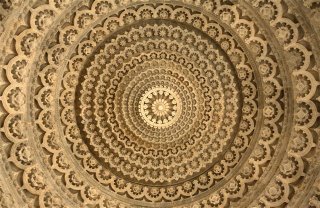
My suspicions that the only "credible" or "real" monuments of the ancient Indian artisanry to them were the ones that were old were confirmed when I read one of the comment sheets after the guests left - "I'll be glad to be in Varanasi tomorrow."

Now I sincerely hope these scholars aren't guilty of believing that only old things are really traditional. Archaeologists would love to be able to reconstruct what ancient Roman temples looked like. Marine biologists are amazed when they find "living fossils" that give them insight into what the ancient creatures looked like. Swaminarayan Akshardham represents the revival of an architecural tradition that hasn't been used in over five centuries. It's a living fossil of architecture, yet because it's not old, it seems to be less valuable. Oddly enough, I think it is, in a sense, more valuable BECAUSE it is so new. The whole conceptualization, design, and construction have been meticulously charted and recorded - and can be studied. It's like being able to watch evolution happen.

On the other hand, I can understand to an extent the "kitschy" perception of the boat-ride. New media are always rejected at first, but over time, become accepted as ways of transmitting messages to a populous. Roman Catholics rejected sculpture and painting as methods of transmitting religious messages and stories because the 'traditional way' of doing it was through long hand-written books that only monks could read anyway. Eventually, Michelangelo, da Vinci, and other great artists brought about a new "tradition." In this day and age, 'traditional' means prayer in quiet repose and didactic presentations by ministers and priests. Even Lakewood Church experiences a rejection of non-traditional ways. But as the author of the preceding article puts it, "Much criticism of Christians by other Christians comes from differences in priorities." I definitely think the "difference in priorities" comes into play at Akshardham as well. Nevertheless, I'm willing to bet that in 50 years, the use of technology to present morals and values messages will be the 'tradition' and society will simply start rejecting the next new thing.

I guess its to be expected then that these scholars, who make careers out of studying the old ways would lack the interest of studying something new. It's just disappointing that a living past stands before them, but they won't see it until it, too, becomes old.

*holy bath ritual where sacred water is poured over the murti of God.

Wednesday, October 11, 2006

New Pictures and Mail

I've added a few new pictures of my Guru, Pramukh Swami Maharaj. I took these pictures on September 7th/8th, during the Chandra Grahan, or lunar eclipse that lasted from 11:30 PM to 1:30 AM. Eclipses are inauspicious occasions that are passed by spending that time in the worship of God, hence the late-evening session where I took these pictures. Pramukh Swami Maharaj, now 86, had just recently recovered from a bout with a cold and was his normal, joyous, smiling self again, much to the pleasure of all the devotees present.

Scroll down the page to the Flickr Box where My Latest Pictures are, or click here to see them in a new page. I apologize again for the tediously slow addition of photos to this page. That I can't bring my gadgets into Akshardham, and the ridiculously slow internet access here means that I can't put up pictures regularly. I'm sure this frustrates those of you who know what an insatiable shutterbug I am, but please bear with me. Once I begin travelling, you'll get more than you bargained for. Promise.

Also, for those of you that would like your own picture of Swaminarayan Akshardham, the bookstore has recently obtained postcards - beautiful ones - and I will send you a postcard if you will email me your address.

Tuesday, October 10, 2006

A Bit of Political Commentary...

I don't mean to use this blog as a place of political commentary, but I can't resist this one.

Does anyone else find it odd that we went to war with Iraq because we THOUGHT they had WMD's and urge only sanctions upon North Korea, who very obviously DO have them? Is it just me or is this logic a bit backward? And isn't it a bit strange that we won't let anyone else have Nuclear Weapons but we're allowed to have 5,735 of them?

Maybe some people will leave comments on this one.